
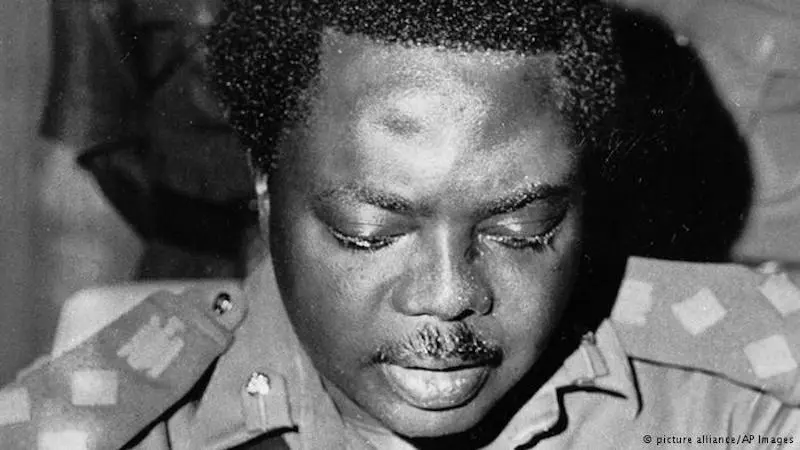
General Murtala Ramat Mohammed is one of the most consequential and celebrated figures in Nigerian history.
As Nigeria’s fourth Head of State, he ruled for just seven months from July 29, 1975, to February 13, 1976 yet his impact on the country was so profound that he is widely regarded as a national hero.
Fearless, decisive, and deeply committed to Nigerian sovereignty and African liberation, Murtala Mohammed initiated sweeping reforms, launched bold foreign policy initiatives, and set Nigeria on a path toward civilian rule before his tragic assassination cut his tenure short.
His face graces the Nigerian twenty-naira note, an enduring symbol of the nation’s love and respect for his memory.
Profile
| Full Name | Murtala Ramat Muhammed |
| Born | November 8, 1938 |
| Died | February 13, 1976 (aged 37) |
| Birthplace | Kurawa Quarters, Kano, Northern Nigeria (now Kano State) |
| State of Origin | Kano State, Nigeria |
| Nationality | Nigerian |
| Occupation | Military Officer, Head of State |
| Religion | Islam |
| Parents | Muhammad Riskuwa (Father), Uwani Rahamatu (Mother) |
| Siblings | 7 (second of eight children) |
| Spouse | Hafsatu Ajoke Muhammed (married 1963) |
| Children | 6, including Aisha Muhammed |
| Military Rank | General |
| Tenure as Head of State | July 29, 1975 – February 13, 1976 |
Early Life
Murtala Ramat Mohammed was born on November 8, 1938, in the Kurawa Quarters of Kano City in the Northern Region of British Nigeria (now Kano State, Nigeria). He was the second of eight children born to Muhammad Riskuwa and Uwani Rahamatu a respected family with deep roots in the Kano emirate and strong ties to Islamic tradition. He was earlier known as Murtala Rufai Mohammed but adopted the name Murtala Ramat Mohammed upon his ascension to power.
Growing up in Kano during British colonial rule, Murtala was instilled from an early age with a strong sense of Nigerian identity, discipline, and national duty. The colonial environment shaped his awareness of African sovereignty and fired his ambition to serve his country. He displayed leadership qualities and intellectual sharpness from his youth, qualities that would define his meteoric rise through the ranks of the Nigerian military.
Education
Murtala Mohammed received his early education in Kano and went on to attend Barewa College in Zaria, one of Nigeria’s most prestigious secondary schools and an institution known for producing many of the country’s most distinguished leaders. After completing his secondary education, he enrolled in the Nigerian Army and received his formal military training at the prestigious Royal Military Academy Sandhurst in England the same institution that has trained British royalty and military leaders for centuries. He was commissioned as a Second Lieutenant in 1961.
He further sharpened his skills at the Catterick School of Signals and the Joint Services Staff College, both in England, becoming one of the most technically and strategically prepared officers of his generation in the Nigerian Army.
Military Career
Murtala Mohammed’s military career began formally in 1958 when he enlisted in the Nigerian Army. After his commissioning in 1961, he was assigned to the Signals Corps and served as part of the Nigerian contingent to the United Nations Peacekeeping Force in the Congo his first exposure to international military operations. On his return, he resumed duties with the Signals Corps of the Nigerian Army.
During Nigeria’s turbulent political period of the mid-1960s, he played a key role in the 1966 counter-coup, which overthrew the military government of Major-General Johnson Aguiyi-Ironsi following the first military coup of January 1966. He became a prominent figure in the northern-led military establishment that subsequently took power under Yakubu Gowon.
During the Nigerian Civil War (1967–1970), Murtala Mohammed served as the first General Officer Commanding (GOC) of the Second Infantry Division, leading the division’s operations in the Midwest Region. His role in the war, particularly in the invasion of the Midwest and the battles at Onitsha, made him a controversial but undeniably significant military commander. The Second Division’s conduct during the war later attracted scrutiny and criticism, but Murtala’s personal bravery and military capability were never in doubt.
By 1971, he had risen to the rank of Brigadier General. He continued to serve in various military and administrative capacities until the pivotal events of 1975.
As Head of State (1975–1976)
On July 29, 1975, a bloodless military coup ousted General Yakubu Gowon while he was attending an OAU summit in Kampala, Uganda. Murtala Mohammed emerged as the new Head of State and Commander-in-Chief of the Armed Forces of Nigeria, with General Olusegun Obasanjo as his Chief of Staff.
Murtala’s seven-month rule was arguably the most dynamic and consequential brief tenure in Nigerian political history. His government took immediate, bold action across multiple fronts:
Public Service Reform: He launched a massive restructuring of the Nigerian civil service and armed forces, retiring or dismissing thousands of civil servants, military officers, judges, and other officials deemed corrupt, incompetent, or inefficient. The purge was swift and uncompromising, reflecting his zero-tolerance for mediocrity and corruption.
State Creation: His government created seven additional states, bringing the total to 19, to improve administrative efficiency and bring governance closer to the people.
Capital Relocation: He initiated the process of moving Nigeria’s federal capital from Lagos to Abuja, appointing a committee whose findings eventually led to the official relocation of the capital a project realized long after his death but one of his most enduring legacies.
Return to Civilian Rule: He announced a clear political program and timetable for returning Nigeria to civilian rule by October 1, 1979, setting in motion the constitutional and electoral processes that would eventually lead to the Second Republic.
Foreign Policy: Murtala Mohammed pursued a bold and assertive African foreign policy. He was an outspoken critic of Western imperialism and a strong supporter of African liberation movements. His government played a decisive role in supporting the MPLA in Angola against South African-backed UNITA forces, directly challenging US and South African interests on the continent a move that earned him enormous respect across Africa.
Assassination
On the morning of February 13, 1976, Murtala Mohammed was assassinated in Lagos during an abortive military coup led by Colonel Bukar Suka Dimka. While being driven to work on Lagos’s Third Mainland Bridge, his convoy was ambushed. Murtala Mohammed was shot and killed at the age of just 37. The coup failed, and Dimka was later executed, but Nigeria had lost one of its most dynamic and visionary leaders. The nation mourned deeply, and Murtala’s successor, General Olusegun Obasanjo, continued many of his policies, including the transition to civilian rule.
Legacy
Murtala Mohammed’s legacy in Nigeria and across Africa is immense. He is commemorated on the Nigerian twenty-naira note. Lagos’s international airport, now Murtala Muhammed International Airport, is named in his honor. The Murtala Muhammed Foundation (MMF), established by his family, continues to carry forward his ideals through development projects focused on equity, good governance, and economic empowerment across Africa. He is remembered as a man of the people decisive, incorruptible, and fiercely committed to Nigeria and Africa.
Personal Life
Murtala Mohammed married Hafsatu Ajoke Muhammed (née Ajoke) in 1963. She was born on May 23, 1941, and served as Nigeria’s Fourth First Lady during her husband’s tenure. The couple had six children together, including their daughter Aisha Muhammed. Ajoke Muhammed survived her husband’s assassination and has since devoted much of her life to conservation and humanitarian causes. Murtala was known for his strong Islamic faith, his personal integrity, and his straightforward, no-nonsense character qualities that earned him the deep affection of the Nigerian people during and after his lifetime.
Net Worth
As a career military officer and public servant, Murtala Mohammed was not known for personal wealth accumulation. His tenure was characterized by his crusade against corruption and his emphasis on national service over personal gain which only enhanced his reputation as an honest and selfless leader. His legacy is measured not in personal financial terms but in the enduring institutional and cultural impact of his seven months in power.
FAQs
When was Murtala Mohammed born?
He was born on November 8, 1938, in Kano, Nigeria.
How did Murtala Mohammed die?
He was assassinated on February 13, 1976, during a failed military coup in Lagos.
What is Murtala Mohammed remembered for?
He is remembered for his sweeping anti-corruption reforms, his bold African foreign policy, initiating the relocation of Nigeria’s capital to Abuja, and setting the timetable for a return to civilian rule.
What is named after Murtala Mohammed?
Lagos’s international airport is named Murtala Muhammed International Airport in his honor. He also appears on the Nigerian twenty-naira note.
How long did Murtala Mohammed rule Nigeria?
He ruled for approximately seven months, from July 29, 1975, until his assassination on February 13, 1976.
Conclusion
Murtala Ramat Mohammed was a man of extraordinary courage, vision, and conviction. In just seven months as Nigeria’s Head of State, he achieved more than many leaders do in years reforming the civil service, pursuing African liberation, setting the course for the capital move to Abuja, and charting a clear road to democracy.
His assassination robbed Nigeria of a transformative leader at the height of his powers. Decades later, his legacy endures in the hearts of Nigerians and across Africa as a symbol of fearless, principled leadership and genuine commitment to the African cause.