
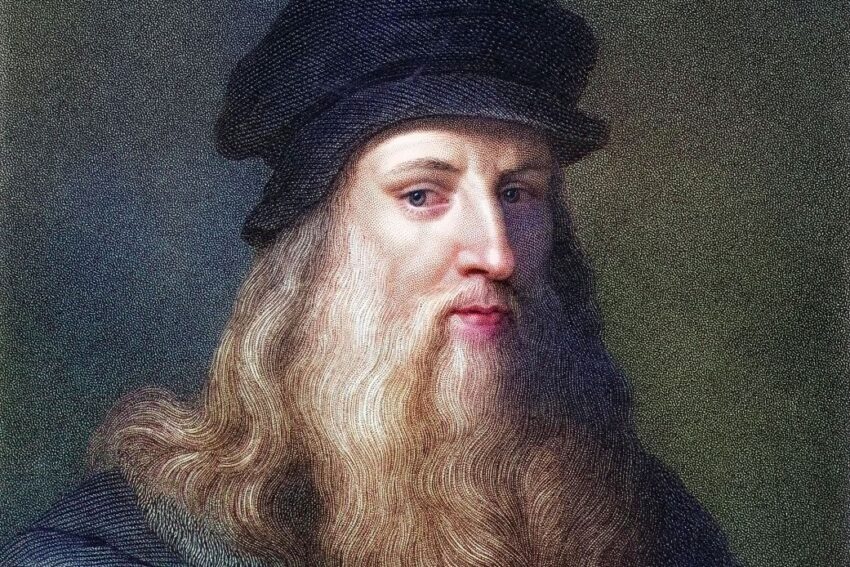
Leonardo da Vinci stands as arguably the greatest genius in human history a man so far ahead of his time that many of his ideas and inventions were not fully understood or realized until centuries after his death.
A painter, sculptor, architect, engineer, scientist, mathematician, anatomist, botanist, musician, and writer, Leonardo embodied the spirit of the Renaissance more completely than any other person of his era.
His name is synonymous with artistic and intellectual greatness, and his works from the Mona Lisa to the Last Supper remain among the most studied and celebrated in the history of human civilization.
Leonardo da Vinci Profile
| Full Name | Leonardo di ser Piero da Vinci |
| Born | April 15, 1452 |
| Died | May 2, 1519 (aged 67) |
| Birthplace | Anchiano, near Vinci, Republic of Florence (now Tuscany, Italy) |
| Nationality | Italian |
| Occupation | Painter, Sculptor, Architect, Scientist, Engineer, Inventor, Anatomist, Writer |
| Parents | Ser Piero da Vinci (Father – Notary), Caterina (Mother – Peasant) |
| Siblings | 12 (half-siblings) |
Early Life
Leonardo da Vinci was born on April 15, 1452, in Anchiano, a small hamlet near the town of Vinci in the Republic of Florence, present-day Tuscany, Italy. He was the illegitimate son of Ser Piero da Vinci, a 25-year-old Florentine notary and landlord, and Caterina, a young peasant woman. His parents never married, and shortly after his birth, his father took custody of him and raised him in the family estate in Vinci. His mother later married an artisan and lived separately.
Growing up in his paternal grandfather’s household in Vinci, Leonardo had access to scholarly texts and was exposed to Vinci’s longstanding painting and artistic traditions. He was the eldest of twelve half-siblings but was never treated as an outsider. Like his siblings, he received a basic education in reading, writing, and arithmetic. From childhood, he displayed an extraordinary curiosity about the natural world sketching animals, plants, and landscapes with a precision and sensitivity that far exceeded his years.
Education
Leonardo da Vinci did not receive a formal university education, unlike many scholars of his era. However, at approximately age 14–15, his father recognized his extraordinary artistic talent and apprenticed him to the renowned Florentine artist and sculptor Andrea del Verrocchio, whose workshop was one of the most prestigious in all of Florence. Verrocchio’s bottega undertook a wide variety of commissions sculpture, decorative metalwork, and paintings and Leonardo absorbed knowledge across all these disciplines.
Leonardo’s genius became apparent even within Verrocchio’s workshop. It is widely held that in one of Verrocchio’s paintings, the Baptism of Christ, the angel painted by the young Leonardo was so superior in quality that the master reportedly put down his brush and never painted again. In 1472, Leonardo was accepted into the Painters’ Guild of Florence (Compagnia di San Luca), a formal recognition of his professional status, though he continued to work under Verrocchio for another five years.
Career
Leonardo da Vinci’s professional career unfolded across several distinct periods and cities. His first major independent commission came in the late 1470s in Florence, where he began work on the Adoration of the Magi an ambitious, innovative composition that remained unfinished when he left for Milan around 1481–1482.
In Milan, Leonardo served for nearly two decades under the patronage of Ludovico Sforza, Duke of Milan. During this period, he produced some of his most enduring masterpieces, including The Virgin of the Rocks and the monumental Last Supper (circa 1495–1498), painted on the wall of the refectory of Santa Maria delle Grazie. He also designed an enormous equestrian bronze monument for Sforza, though it was never cast. In addition to art, he filled thousands of pages of notebooks with observations, theories, and designs spanning anatomy, architecture, optics, hydraulics, mechanics, and more.
When French forces invaded Milan in 1499, Leonardo left and spent time in Venice and possibly Rome and Naples, before returning to Florence. There, around 1503, he reportedly began work on his most famous painting the Mona Lisa. He also received a commission (with the help of Niccolò Machiavelli) to paint the Battle of Anghiari, which remained unfinished. During this period he continued his extraordinary anatomical studies, dissecting over 30 human corpses to produce some of the most accurate anatomical drawings in history.
From 1513 to 1516, he worked in Rome under the patronage of the Medici, maintaining a workshop and undertaking diverse projects for the Pope. In 1516, following the death of his patron Giuliano de’ Medici, King Francis I of France offered Leonardo the prestigious title of Premier Painter, Engineer, and Architect of the King, and Leonardo spent his final years in France at the Château du Clos Lucé, near the royal palace at Amboise. He died on May 2, 1519, at the age of 67, leaving his estate and thousands of drawings and notebooks to his devoted pupil Francesco Melzi.
Famous Works
- Mona Lisa (c. 1503–1519) Louvre Museum, Paris. Considered the most famous painting in the world.
- The Last Supper (c. 1495–1498) Santa Maria delle Grazie, Milan.
- The Vitruvian Man (c. 1490) Gallerie dell’Accademia, Venice.
- The Virgin of the Rocks two versions, Louvre and National Gallery, London.
- Salvator Mundi sold at auction in 2017 for a record $450.3 million.
- Lady with an Ermine, Ginevra de’ Benci, Adoration of the Magi, St. John the Baptist, The Annunciation.
Inventions and Scientific Contributions
Beyond painting, Leonardo’s notebooks reveal a mind centuries ahead of its time. He conceptualized designs for a flying machine (ornithopter), a helicopter, a tank, a solar power concentrator, a calculator, a rudimentary robot, and a double-hull ship, among dozens of other inventions. His anatomical drawings of the human body, produced from direct cadaver dissection, remain some of the most accurate ever made. He studied geology, botany, hydrodynamics, and optics with a scientific rigor that was unprecedented in his era.
Personal Life
Leonardo da Vinci never married and left no known descendants. He was famously private about his personal life. Scholars and biographers have long debated his sexuality, with many concluding he was likely homosexual or asexual, based on various historical clues. In 1476, he and several other men were anonymously accused of sodomy with a male model in Florence, though the charges were dropped. His closest companions were his pupils and apprentices, most notably Salaì (Gian Giacomo Caprotti da Oreno), who joined his studio in 1490, and Francesco Melzi, who became his most devoted pupil and heir. Leonardo was also a known vegetarian and had deep compassion for animals. He was left-handed, wrote in mirror script (right to left), and maintained his characteristic relentless curiosity until his final days.
Net Worth
As a Renaissance artist who lived centuries ago, quantifying Leonardo’s wealth in modern terms is speculative. However, he was a well-compensated court artist who received generous patronage from some of the most powerful rulers in Europe, including Ludovico Sforza and King Francis I of France. His works are today priceless cultural treasures. The Salvator Mundi, sold in 2017 for $450.3 million, is the most expensive painting ever auctioned a testament to the incalculable value the world places on his art.
FAQs
When was Leonardo da Vinci born? He was born on April 15, 1452, in Anchiano, near Vinci, Italy.
What is Leonardo da Vinci most famous for? He is most famous for painting the Mona Lisa and The Last Supper, and for his extraordinary scientific notebooks and inventions.
Did Leonardo da Vinci have any children? No, he never married and had no known children.
How did Leonardo da Vinci die? He died on May 2, 1519, at Clos-Lucé, France, reportedly from a stroke, at the age of 67.
What language did Leonardo da Vinci write in? He wrote in Italian, using his distinctive left-handed mirror script.
Conclusion
Leonardo da Vinci was not simply an artist or a scientist he was a one-of-a-kind intellect whose curiosity and genius transcended every boundary of human knowledge. Five centuries after his death, his paintings still captivate millions of viewers, his scientific ideas still inspire engineers and inventors, and his life story still motivates people to pursue knowledge, creativity, and excellence without limits. In every meaningful sense, Leonardo da Vinci was and remains the ultimate Renaissance man.