
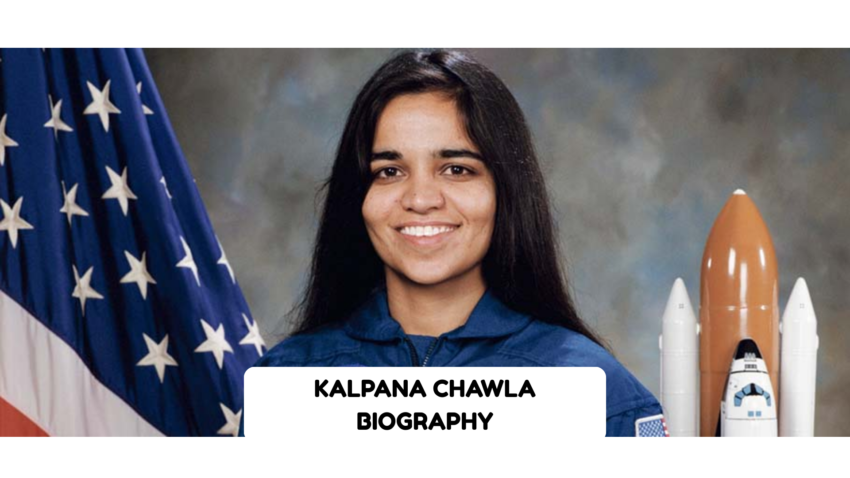
Kalpana Chawla was a trailblazer who etched her name in history as the first woman of Indian origin to fly into space.
Her life reflects unwavering dedication, passion for aerospace, and inspiration for generations of students and explorers worldwide. Born in India and rising to become a NASA astronaut, her remarkable story remains one of the most inspiring in the history of space exploration..
Early Life
Kalpana Chawla was born on March 17, 1962, in Karnal, Haryana, India, into a Punjabi Hindu family. Her father, Banarsi Lal Chawla, ran a tire business, while her mother Sanjogta Kharbanda encouraged her academic interests. From a young age, Kalpana was fascinated by flying and space, often watching planes fly overhead and dreaming of the stars.
She excelled academically, particularly in mathematics and science, and attended Tagore Baal Niketan Senior Secondary School before undertaking pre-engineering studies at Dyal Singh College and then at Punjab Engineering College. There, she became one of just a few women studying aeronautical engineering and the first woman student at that program.
Academic Journey: From India to America
Undergraduate Education in India
Kalpana began her formal engineering journey in India, earning a Bachelor of Engineering (BEng) in Aeronautical Engineering from Punjab Engineering College, Chandigarh in 1982. Her choice of aerospace was unconventional — especially for a woman at the time — and she faced discouragement from some professors who suggested other disciplines. Despite this, she persisted and excelled.
Higher Education in the United States
With limited aerospace education options in India, her passion led her to the United States:
- M.S. in Aerospace Engineering from the University of Texas at Arlington (1984).
- Ph.D. in Aerospace Engineering from the University of Colorado Boulder (1988), where her doctoral research focused on aerodynamic flows.
While in the U.S., she also learned to fly, earning commercial pilot’s licenses and instructor ratings for single-engine, multi-engine aircraft, gliders, and even seaplanes — a testament to her love for flight.
She met her future husband, Jean-Pierre Harrison, a pilot and aviation author, during her studies and married him in 1983.
NASA Career: From Researcher to Astronaut
In 1988, Kalpana began her career at NASA’s Ames Research Center, contributing to computational fluid dynamics research — simulations that help understand airflow around aircraft. Her work advanced NASA’s understanding of aerodynamic systems.
She later became vice president and research scientist at Overset Methods, Inc., a nonprofit research firm in California, before re-joining NASA to pursue astronaut training.
In 1994, she was selected for the NASA astronaut corps after rigorous screening and began intensive astronaut training at the Johnson Space Center in Houston. Her roles included working with robotics, extravehicular activities (EVAs), and mission systems.
Historic Space Missions
First Spaceflight: STS-87 (1997)
Kalpana made her first voyage into space aboard STS-87 on the Space Shuttle Columbia, launching on November 19, 1997. This mission marked a historic milestone — she became the first woman of Indian origin to travel into space.
During STS-87:
- She served as mission specialist and prime robotic arm operator.
- The shuttle completed 252 orbits of Earth.
- The mission carried experiments studying microgravity and plant growth.
Though one experiment satellite (SPARTAN-201) malfunctioned at deployment, her calm, professional handling of complex tasks earned widespread respect.
Second and Final Mission: STS-107 (2003)
Kalpana’s second mission, STS-107, was primarily research-focused and launched on January 16, 2003 aboard Columbia once again.
This mission:
- Conducted over 80 scientific experiments in microgravity, fire science, biology, physics, and material sciences.
- Employed a 24-hour shift schedule to maximize research work.
Tragically, on February 1, 2003, Columbia disintegrated during re-entry due to damage from insulating foam that struck the shuttle’s wing during launch. All seven crew members, including Kalpana, lost their lives.
Achievements, Honors & Recognition
Kalpana Chawla’s contributions and sacrifices continue to be celebrated globally. Her posthumous honors include:
- Congressional Space Medal of Honor (2004) — one of the highest U.S. civilian awards.
- NASA Space Flight Medal and NASA Distinguished Service Medal.
- Asteroid 51826 Kalpanachawla named in her honor.
- Numerous institutions, scholarships, and memorials dedicated to her legacy.
- Northrop Grumman’s Cygnus cargo spacecraft named S.S. Kalpana Chawla.
Legacy & Global Impact
Kalpana’s journey inspires millions around the world — especially women pursuing STEM fields. Her story is a testament to:
Dreams without borders — from Haryana, India, to NASA’s astronaut corps.
Courage and perseverance — succeeding in a male-dominated field.
Scientific curiosity — advancing space research.
Role model for young women — proving gender never limits achievement.
Her famous quote continues to inspire:
“The path from dreams to success does exist. May you have the vision to find it, the courage to get on to it, and the perseverance to follow it.”
Frequently Asked Questions (FAQs)
1. Who was Kalpana Chawla?
Kalpana Chawla was an Indian-born American aerospace engineer and NASA astronaut, the first woman of Indian origin to fly in space.
2. Where was Kalpana Chawla born?
She was born in Karnal, Haryana, India, on March 17, 1962.
3. What were her space missions?
She flew on STS-87 (1997) and STS-107 (2003) aboard the Space Shuttle Columbia.
4. How did Kalpana Chawla die?
She died when Space Shuttle Columbia disintegrated during re-entry on February 1, 2003.
5. What is her legacy?
She continues to inspire students globally, especially in STEM fields, and has numerous awards and memorials in her honor.
Conclusion
From a young girl in Haryana fascinated by aircraft to a pioneering astronaut who touched the skies, Kalpana Chawla’s life is a story of courage, vision, and achievement. Her legacy transcends borders and continues to motivate millions to pursue their dreams — no matter how lofty.
Her dedication to science and space exploration remains one of the most compelling chapters in human history.